Andy Warhol and the NYPL Picture Collection
Andy Warhol and the NYPL Picture Collection
~~~
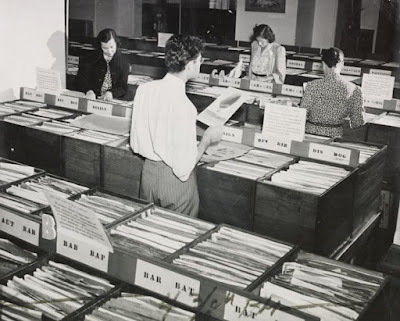
Andy Warhol's reputation as the consummate appropriator of visual culture is well established, but what is often overlooked is how deeply this practice of appropriation was tied to the infrastructure that made it possible- namely the New York Public Library's Picture Collection. This massive visual archive, open to artists, illustrators, designers and the general public served as a wellspring of imagery ready to be borrowed copied, or transformed. If Warhol's genius was in recognizing the artistic and commercial potential of appropriation, then perhaps the true progenitor of Pop Art was not Andy Warhol himself but the institutional collection that allowed him to reframe the visual language of consumer culture. The NYPL Picture Collection, with its democratic access to visual media, may have been the hidden engine that powered not only Warhol's artistic process but others as well, including fellow users Robert Rauschenberg and Joseph Cornell.
From his earliest years, Warhol's relationship with visual reference material bordered on obsession. As a student at Carnegie Institute of Technology, he studied and replicated Ben Shahn's linear drawing techniques, mastering the art of Shahn's ink transfer print style rather than inventing it. This formative act of aesthetic mimicry prefigured the ethos that would later define Pop Art- the elevation of repetition, citation, and mass imagery as legitimate artistic methods. When Warhol moved to New York to work as a commercial illustrator, he found in the NYPL Picture Collection an inexhaustible resource for his artistic and professional ambitions. The collection, organized by subject and filled with photographs, magazine clippings, and reproductions, provided an encyclopedic archive of visual references. Warhol checked out over a thousand items from the Picture Collection, now housed in the Warhol Museum archives. These include clippings that became direct sources for his art- among them, a Coca-Cola advertisement and a photograph of flowers. These were not merely inspirational materials; they were the raw data for Pop.
The NYPL Picture Collection's importance lies in its role as a mediator between the private artist and the public world of images. It democratized access to visual reference material, collapsing distinctions between "high" and "low" art in a way that directly anticipated Pop Art's aesthetic. anyone could walk in and borrow an image of Marilyn Monroe, a soup can, or a magazine advertisement- the very icons Warhol would later immortalize. In this sense, Warhol's studio practice mirrored the library's structure: a collection of borrowed, recycled, and reorganized images that together mapped the visual consciousness of mid-century America. His art did not emerge from isolated genius but from a system of visual exchange facilitated by public institutions.
Moreover, the Picture Collection's influence extended beyond Warhol's individual practice. The accessibility of mass imagery helped cultivate a generation of artists who were less concerned with originality and more interested in meditation, reproduction, and the circulation of signs. The ethos of appropriation that defined the 1960s and beyond- seen in artists like Roy Lichtenstein, Ricard Prince, and later, Sherrie Levine- can be traced back to this shift. The library was not just a resource; it was a conceptual model for Pop Art's engagement with the mass media. Its vast archive of visual references anticipated the internet's image culture, in which everything is available to be borrowed, remixed, and recontextualized.
Warhol's legal case with the flower photograph by Patricia Caulfield is emblematic of the blurred boundaries between ownership and creativity that the Picture Collection enabled. By using a photograph without permission and transforming it into one of his most recognizable silkscreens, Warhol enacted the very principle that Pop Art celebrated- the re-use of the already seen, the transformation of the banal into the iconic. Yet this act also raises the question: If Warhol's genius lay in recognizing the artistic potential of what was already circulating, was he not merely extending the logic of the Picture Collection itself? The library collected images; Warhol collected reproductions. The library catalogued and lent them; Warhol reprinted and sold them. In a sense, his Factory output was a mirror of the Picture Collection- an industrialized system for the reproduction and redistribution of visual culture.
Thus, to understand Warhol's appropriation not as theft but as a continuation of institutional processes is to reposition the origins of pop Art. The NYPL Picture Collection was the pro-Pop archive, a repository of American Imagery that invited reinterpretation. Warhol's brilliance was in perceiving that these borrowed images could become not just tools for ilustration but the very content of fine art. In transforming the everyday imagery of the Picture Collection into commodities of high culture, he completed a cycle of visual consumption that began in a public library drawer.
In this light, Pop Art's source was not only in Madison Avenue advertising or consumer packaging but in the quiet, democratic architecture of the Picture Collection- a ssystem that made visual culture accessible, reproducible, and ultimately, commodifiable. The library did not just feed Warhol's imagination; it provided the blueprint for an entire movement grounded in the circulation of images. Warhol may have been PopArt's visible face, but the Picture Collection was its invisible foundation- the true archive of the American gaze.
Anthony Troncale
Posted November 20, 2025
Find out more about the NYPL Picture Collection-


Comments
Post a Comment