The Organization of Vision: Romana Javitz and the New York Public Library’s Picture Collection

Origins: an immigrant, an art student, and an “untrained” librarian
Romana Javitz was born in Russia in 1903 to Polish parents and immigrated to New York as a child. Her family settled in the Bronx and on the Upper West Side; her mother was a hat milliner and her father an importer of fine woods, giving the family a modest middle‑class footing and daily contact with materials, texture, and craft. This background – immigrant and artisanal at once – matters for understanding her later commitments: she instinctively took seriously both “high” art and the visual culture of ordinary life and work (Worth Beyond Words, pp. 6–7; Words on Pictures, passim).
She entered the New York Public Library young, first in the Children’s Room (1919), then part‑time in the Picture Collection (from 1924), while studying painting at the Art Students League rather than library science (Worth Beyond Words..., p. 6; Staff News Appendix, p. 161). In the 1920s she also traveled through Italy, Austria, Poland, Germany, France, and England, deliberately visiting museums and libraries to study “the organization and content of documentary pictorial collections” and especially how European governments subsidized pictorial records of folk costume and daily life:
“Everywhere I went I found that the record of folk arts [was] exceedingly rich and well preserved and that the governments had been interested in subsidizing this recording and documentation. . . . It seemed shameful to me then that we had not developed pride enough in our own past to record the appearance of what the people wore, the details of their kitchens, their tools, their houses.”
(Worth Beyond Words, p. 6; her letter to Holger Cahill, 1949)
This sense of shame and possibility – that the United States lacked basic visual records of “its own” life – became a driving motive for everything she did afterwards. It also positioned her differently from contemporaries trained as catalogers. She came to pictures as an artist and user first, not as a guardian of abstract bibliographic order.
In 1928 the founding head of NYPL’s Picture Collection, Ellen Perkins, retired. Javitz, still relatively young and without formal library credentials, was made superintendent in 1929 (Worth Beyond Words, p. 6; Staff News Appendix, p. 161). That appointment gave her an institutional base from which she would, over nearly forty years, reshape how American libraries and artists understood pictures.
Rebuilding the Picture Collection as a tool for creative work
From school‑room syllabi to professional image lab
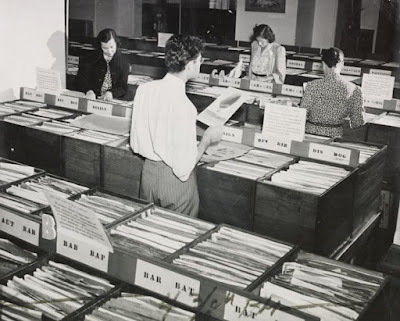
When Javitz took over, the Picture Collection’s organization was largely inherited from John Cotton Dana’s school‑oriented picture files in Newark. Subjects like “Forms of Land and Water” meant that a researcher looking for Niagara Falls had to know to look under F and then mentally map their request to a pedagogical category (Worth Beyond Words, p. 6; Yampolsky interview, pp. 138–139). This made sense for classroom teachers following geography syllabi; it was nearly useless to working artists, designers, and researchers who came in asking for “Niagara Falls,” “Russian ornament,” or “an Amish bonnet.”
As she later explained:
“The classification system was so geared to educational purposes, that it couldn’t help a designer at all. The files were very unimaginative.”
(Yampolsky interview, p. 128)
One of her earliest contributions was to insist that the Picture Collection had to serve a different public: commercial artists, illustrators, set and costume designers, photographers, and writers of every level, not just schools. She therefore began to reorient the entire apparatus around users’ language and needs.
Open access, circulation, and “call slips” as data

Javitz pushed the Picture Collection toward an open‑shelf model and a circulation system with its own borrowers’ card. By the end of her first decade the collection had become an “open‑shelf type of library,” issued its own cards, and lent unmounted pictures for people to take back to studios, classrooms, and offices (Worth Beyond Words, p. 16; Picture Collection Annual Report, 1939). For artists, this was transformative. They could literally spread dozens of images out beside their drawing board or sewing table and work directly from them.
She also addressed a fundamental communication gap: many researchers were immigrants or non‑native English speakers, and even native speakers did not necessarily know what terms librarians would use. In 1931 she instituted a simple but powerful policy: every user requesting pictures had to write or draw what they wanted on a call slip (Worth Beyond Words, p. 9). That served several functions at once:
• It overcame language barriers—people could sketch what they meant.
• It created a continuous record of demand patterns.
Those slips were systematically collected and analyzed. Over time, they became a forecasting tool for shifts in taste and industry. She recalled that from these slips one could “foretell the next season in fashion” – for instance, a sudden spike in requests for Russian‑style side‑button blouses or plaid designs indicated what manufacturers were about to produce and what other designers would soon imitate (Yampolsky interview, p. 129).

By allowing researchers to describe images in their own terms, or by their own illustration, Picture Collection staff can more efficiently direct them to the appropriate files. The terms used by the public are also compiled and integrated into the subject headings to better reflect and update ever-changing nomenclatures.
Note: See also recently digitized Unfilled Calls, 1925-1928 from internal Picture Collection records.
This was an early, informal version of user‑driven metadata and demand analytics. Instead of imposing a subject language from above, she used these traces to build and revise the headings so that they matched how people actually described things in 1930s New York.
Subject access based on how pictures function, not how books are cataloged
The largest intellectual contribution of Javitz’s career may be her rethinking of subject access for pictures. From the Carnegie‑funded essay “The Organization of Pictures as Documents” (1941–42) through decades of practice, she argued that visual materials could not be satisfactorily organized with bibliographic schemes designed for books (Introduction, pp. 8–9; Words on Pictures, passim).
She formulated both a theory and a working system. The theory is clear in “On Pictures in a Public Library” (her 1939 Grade 4 thesis): pictures function both as art and as documents, and their usefulness as documents depends on:
• the information attached to them (who, what, when, where),
• and the possibility of comparing many related images at once.
She insisted that documentary value increases with accurate identification, even for technically mediocre images:
“As far as its documentary function is concerned, a picture with full identification, although technically mediocre is of more use than a good picture without identification.”
(Words on Pictures, p. 55)
On the practical side, she devised a hybrid classification that combined alphabetical subject headings with a flexible, non‑alphabetic structure summarized in the mnemonic RSTY – Region, Style, Type, Year (Yampolsky interview, pp. 130–133):
• Style: for cross‑period fashions such as “Louis XV,” “Edwardian,” “Biedermeier.”
• Type: for forms that can cut across regions and periods once there are enough images (e.g., Knitwear, Lounging, Babies under Costume).
• Year: for fashion‑driven phenomena where chronology is overriding—for example, middle‑class dress, hairdressing, city streets.
Crucially, she rejected single‑placement “logic” in favor of practical redundancy:
“There is nothing logical in this thing. There is consistency, but there is no logic. Because you can’t have logic unless you fit it into one field of human knowledge.”
(Yampolsky interview, p. 131)
The aim was not to satisfy a taxonomist but to allow a user to find material through multiple pathways: under New York, under Fishing Boats—Italy, under Architecture—Gaudí, under Personality—Frank Lloyd Wright, and so on, with deliberate duplication where needed (Yampolsky interview, pp. 131–133).
Later she generalized this scheme for use outside NYPL. She noted that RSTY could work “in any language” and that she had successfully applied it to areas like the history of nursing for professional associations (Yampolsky interview, p. 133). That exportability underlines that this was not just local practice but a considered, portable contribution to the theory of image organization.
Building visual records where none existed: folk art, American design, and Black history

American folk art and the Index of American Design
Her early European trip left her with a sense that the United States had neglected its own “folk” material culture—sunbonnets, cradles, peasant tools, kitchenwares—especially compared to countries that had long subsidized pictures of their peasants’ costume and domestic life (Worth Beyond Words, p. 6; Words on Pictures, pp. 63–64). In the early 1930s she found that, for the American scene, “we could give you what the society woman would wear on the Riviera,” but “we couldn’t find a sun bonnet” (Oral History, pp. 145–146). This scarcity was not benign. It meant that designers, artists, and historians had to turn to caricatures and commercial illustrations to imagine American farmers, and it fed the myth that America “had no culture.”
Her response was both rhetorical and institutional. Rhetorically, she argued that pictures of everyday design – quilts, weathervanes, textiles, toys – are crucial documents of national history. Institutionally, she helped initiate a large federal project to remedy the gap.
In 1935, working with textile designer Ruth Reeves and WPA official Frances Pollack, Javitz developed the idea for the Index of American Design, a Works Progress Administration Federal Art Project (Worth Beyond Words, pp. 7–8). As Holger Cahill later summarized:
“The Index idea… resulted from discussions between Romana Javitz, head of The New York Public Library’s Picture Collection, and artists who came to the Library for research… Miss Javitz and the Picture Collection staff had recognized for some time the need for a comprehensive source record of American design.” (Worth Beyond Words, p. 7)
Under this scheme, unemployed commercial artists and illustrators were hired to make meticulous watercolors of American decorative arts—appliqué bedspreads, Shaker furniture, whirligigs, ironwork, tools, toys—from both rural and urban contexts. Administered in its early phase by Javitz, Reeves, and Pollack in New York, the Index eventually expanded to multiple states and produced thousands of renderings, now in the National Gallery of Art (Worth Beyond Words, pp. 7–9).
The Index responded directly to the deficits she had diagnosed in the Picture Collection and more broadly in the national visual record. It also reinforced a principle evident throughout her career: documentary pictures are not limited to photographs. Drawings by trained copyists can be as crucial as camera records, especially for objects that had never been photographed at all.
3.2. Schomburg and the visual history of Black life
Parallel to this, she worked from the early 1930s with Arturo (Arthur) Schomburg, curator of NYPL’s Division of Negro History, Literature and Prints, to build a pictorial record of Black life. She supplied Schomburg with prints, plates, and photographs on African and African American subjects from the Picture Collection. In 1937 she secured, at her request, a substantial donation of Farm Security Administration (FSA) duplicate photographs depicting African Americans (Worth Beyond Words, p. 7; letter to Schomburg, 1937, cited there).
She later described this work in personal terms:
“We were working to give the Negro his past. You see, it was terribly important.”
(Oral History, p. 145)
These efforts fed both into the Schomburg Center’s holdings and back into the main Picture Collection, which assembled a large stock of imagery on African American subjects (Worth Beyond Words, p. 7; photo caption “Drum Majors, Hampton Institute, Virginia”).
Decades later, during the 1960s civil rights era, she noted that demand for such images outstripped the staff’s ability to supply them; government agencies, filmmakers, churches, and schools all turned to NYPL for visual evidence of past Black life, including FSA material (Oral History, pp. 155–156). That pattern – long‑range use of images initially acquired for one purpose (New Deal propaganda) now serving as historical and political evidence – is exactly what she had predicted in her theoretical writing (Words on Pictures, pp. 58–60).
Her contribution in this area was twofold:
• She framed these images as central to American documentary history, not as marginal curiosities.
Pictures as documents: her theory of images, words, and use
Javitz is not only important as an organizer and collector but also as a theorist of visual culture, particularly of how pictures convey information and how that function differs from their aesthetic roles.
Pictures, words, and the documentary function
In “On Pictures in a Public Library” and “The Organization of Pictures as Documents,” she elaborated a view of photographs, film, and reproductive prints as a new kind of mass documentary infrastructure. Several themes recur:
- Dual function: Any picture can function as art or as document depending on how it is used. A Brueghel painting may serve as a documentary source on sixteenth‑century hobby horses while still being experienced as art (Words on Pictures, p. 45)
- Timelessness and accessibility: Pictures can cross language and temporal barriers more readily than texts. A prehistoric drawing of a bison remains intelligible thousands of years later; a seventeenth‑century written description of aging must be translated and retranslated (Words on Pictures, pp. 44, 56).
- Dependence on captions and context: On their own, pictures record external appearances but do not say what those appearances mean. Words – captions, commentary, scripts – are required to anchor time, place, and intent:
“There is nothing inherent in the pictorial image that can give knowledge about the subject except that it gives us the facts of external appearances. We need previous knowledge, familiarity, or a synchronized explanation in order to comprehend in words what we look at.”
(Words on Pictures, p. 52)
She makes the same point about newsreels and documentaries: without commentary and script, film would be “gesture and movement and little more” (Words on Pictures, p. 54).
Quantity and comparison: For documentary use, the value of a picture increases in proportion to the size and variety of the set to which it belongs. A single photograph of a man tells little; a corpus of images of that man, plus comparisons with paintings and other records, allows a “truer appraisal” (Words on Pictures, p. 56). This stands in contrast to art collections, where smallness and selectivity are part of the value.
Neutrality of the collecting institution: In her view, libraries should avoid acting as arbiters of taste in pictorial collections. They should minimize exclusions on aesthetic grounds and focus on “efficiency in availability” (Words on Pictures, p. 56). Selection is the user’s job, not the cataloger’s.
These positions are tightly knotted with her practice: they justify mass clipping of newspapers, the inclusion of advertising drawings and “bad” films as evidence of social attitudes, and the refusal to weed material simply because it is not “high art” (Words on Pictures, pp. 41, 44, 46).
Photographic modernity and visual education
She also offered an integrated account of what cheap, mechanically reproducible images were doing to culture:
• The motion picture close‑up trained the public’s visual habits—our ability to read gesture, texture, and expression (Words on Pictures, pp. 47–48).
• Advertising and cartoons, however trivial, function as documents of “the customs of the day” (Words on Pictures, p. 46).
She argued that “none of us fully comprehends the extent to which our ideas and attitudes have been nourished by our experience with pictures” (Words on Pictures, p. 47). For librarians, this implied a responsibility: pictures must “join books and serve as documents of man’s own aspect and that of the changing times he has lived in” (Words on Pictures, p. 74).
Her oral history shows how she applied this framework to specific bodies of work, particularly the FSA photographs. She insisted on preserving their original groupings and textual materials where possible, and she opposed the museum practice of selecting isolated “masterpieces”:
“One thing that comes over from FSA pictures is that there are no isolated images. The image is a part of a long continuing tale.”
(Oral History, p. 144)
She criticized exhibitions like MoMA’s Family of Man for aestheticizing subject matter while detaching it from that continuity (Oral History, pp. 159–160).
In these arguments, she anticipated later scholarship on visual evidence and documentary photography and articulated, from inside a public library, a sophisticated model of how images, words, and institutions interact.
FSA photographs, government documentation, and the case for ongoing visual record
Her relationship with Roy Stryker and the FSA/Resettlement Administration photographic project is one of the clearest cases where her ideas and advocacy had national consequences.
Advising the Farm Security Administration

General store interior, Moundville, Alabama. 1935, by Walker Evans (FSA#8164A).
Through photographers Walker Evans and Ben Shahn, Stryker learned of the Picture Collection and visited it in 1936. He then sent John Vachon to study its filing system in 1937 (Worth Beyond Words, p. 13; note 15). Javitz traveled to Washington to press a specific point: subject analysis and data gathering had to occur at the moment of picture production:
“I remember going down to Washington and making a plea to Stryker that the subject content of the pictures must be analyzed as soon as they were made […] and I tried to impress upon the importance of the gathering of data with each picture.” (Oral History, p. 147)
Her counsel echoed her theoretical insistence that documentary value depends heavily on identification, captioning, and context.
Housing and using the FSA duplicates
Through Stryker, the Picture Collection obtained a large “duplicate file” of FSA prints—about 40,000 by her later count (Worth Beyond Words, p. 13; Oral History, p. 148). She integrated them into the subject file rather than treating them as a museum‑like, restricted archive. Some were arranged by state (e.g., Georgia), others by subject such as Migrant Workers, with duplications across headings (Yampolsky interview, p. 135). She also pulled out a separate Negro file to support researchers and activists concerned with Black experience (Oral History, pp. 155–156).
She believed that this everyday use – by muralists, playwrights, film producers, sociologists, and students – kept the images “alive”:
“The material that’s in use seems to have more life than the material on the shelf. There is something about something not being used – it atrophies.”
(Oral History, p. 149)
This practical belief dovetailed with her theoretical emphasis on pictures as living documents whose meanings expand with each new user.
By the 1960s, as debates about poverty and race intensified, she was blunt about what the FSA photographs revealed:
“If you want to be bitter there’s the seeds of bitterness right in those pictures… It’s just so hard to believe it’s in our country, the poverty, it’s just unbelievable.” (Oral History, p. 156)
She also observed how the same picture might be used by different groups to opposite rhetorical ends – for instance, a photograph of white “Okies” in shacks used both to indict a system of “poverty among riches” and to show Black audiences that “there are white people who live in shacks and starve” (Words on Pictures, p. 74). That insight underscores her view of pictures as rhetorically flexible yet factually grounded.

Advocacy for a permanent documentary program
Drawing on the FSA precedent, she concluded that the U.S. had demonstrated, briefly, that it was “not afraid to look at ourselves,” but had then abandoned the project. She argued for renewed state support:
“I don’t think that the purpose is to encourage our talent… I think this is more than patronage of the arts. I think it’s beside the point that it uses talent. I think that America showed in two programs to the world that we are not afraid to look at ourselves… Yet we have no government program to produce source material of our own day from year to year.”
(Oral History, p. 153)
She pointed to neglected areas: labor history, industry, teenage culture, architecture like the Verrazano Bridge, the absorption of immigrant communities (Oral History, pp. 153–154, 158). Her critique was systemic: government invested in speech transcripts and paper records but not in visual records that matched the way “camera‑era” citizens actually learned.
This advocacy links her library work to a broader, still unresolved policy question about how societies should deliberately document themselves in images.
Artists, modernism, and the Picture Collection as a creative engine
The Picture Collection under Javitz became a central resource for New York’s artistic and commercial communities. Annual reports and later accounts document its role in everything from wallpaper design to stage costumes.
Serving designers, educators, and industry
In the 1930s and 40s, the Collection mounted exhibits specifically to show “how the commercial artist uses the collection,” displaying textiles, book jackets, trademarks, theater models, and mural designs all derived from borrowed pictures: a Soviet book jacket inspiring a wall fabric; a photograph of piano keys becoming a bookbinding pattern; a print of Venetian glass leading to a ballet backdrop (Annual Report 1930s, p. 19).
Request logs from the period show both the breadth and strangeness of queries: “a footprint of an elephant,” “a lamp in a New York boarding house in 1860,” “the ‘Don’t tread on me’ flag,” a perpetual motion machine, pogroms, burning of books, the “big bad wolf” cartoons, Ohio flatboats, Charleston balustrades, and samplers (Annual Reports, pp. 19, 26, 78, 98). She took pride in the fact that during the war “these were not pictures in an exhibition – they were pictures actively part of the business of the home front” – in factories, hospitals, schools, copywriters’ desks, and war bond displays (Annual Report 1944, p. 88).
After the war, the GI Bill brought veterans into art schools, and instructors brought entire classes to the Picture Collection. Javitz considered this “a rich investment of our time” because it gave the staff “an active role in promoting the quality of future art work,” and she emphasized that this was “still the only free source from which pictures may be borrowed in New York” (Annual Report, 1940s–50s, p. 98).
Her relationships with artists and photographers
Because of this role, she became personally close to many artists and photographers: Ben Shahn, Walker Evans, Dorothea Lange, and many others. Photographers such as Sol Libsohn spoke about her as someone who “really understood” how a street photographer sees and probed him about what “a photographer can give to a painter” (Libsohn interview, pp. 117–122). With Libsohn she debated the differing controls and possibilities of painting versus photography: the painter’s ability to “sum up” a decisive moment versus the photographer’s dependence on catching it as it happens (Libsohn interview, p. 117).
She herself drew sharp, sometimes provocative distinctions—insisting for example that she had “never seen anything erotic in a photograph” and that “a photograph can never be erotic because its reality is too superficial,” whereas drawings by great artists could be (Yampolsky / Oral History, p. 140). Whether one agrees or not, such statements reflect a deeply worked‑out sense of the specific expressive capacities of each medium.
Her influence extended to figures now central to modernist art history. One documented example is Joseph Cornell. As Diana Kamin and Anthony Troncale have shown, Cornell used the Picture Collection as both a quarry and a model, borrowing and photostating images for his collages, box constructions, and film projects, and corresponding with Javitz over two decades (Pictorially Yours..., pp. 4–10).
Cornell saw the Picture Collection as a source of “long chain[s] of poetic pleasures” and thanked her for reproductions that “reminded me afresh of my debt to the Picture Collection & its instigator” (Pictorially Yours, p. 13). He asked her for obscure items – portraits of forgotten nineteenth‑century singers, movie stills, “a Victorian street urchin with a white cockatoo” – in the expectation that she would find them (Pictorially Yours..., pp. 10–11).
Kamin and Troncale argue that Javitz functioned for Cornell less as a muse than as a medium: a person who “bridged past and present,” connected him to far‑flung visual cultures, and understood the “poetry in everyday life and the correspondences between sensorial and cultural registers” that his work relied on (Pictorially Yours..., pp. 3–4, 19–23). That argument is consistent with how other artists spoke of her facilitative role and her own self‑conception as someone who made pictures available without dictating their meanings.
Legacy and assessment
By the time she retired in 1968, Javitz had transformed a municipal clipping room into what one could describe, without exaggeration, as an early analog image database and creative commons. Its methods, and her writings, have continued to influence picture librarians, archivists, and historians of photography.
Several aspects of her contribution stand out:
- A practical, user‑driven classification scheme for images.
Her RSTY framework and insistence on multiple, overlapping access points offered an alternative to purely bibliographic subject headings. Later scholarship on image classification and metadata echoes many of her concerns about language, flexibility, and cross‑cultural applicability (see Kamin, “Mid‑Century Visions,” cited in the Words on Pictures bibliography). - A robust theory of pictures as documents.
Long before “visual literacy” became a standard phrase, she argued that pictures are “another language” that must be learned, that captions and context are integral to their meaning, and that they are central sources for the study of science, ethnology, and history, not mere illustrations (Words on Pictures, pp. 44, 58, 70, 74; Oral History, pp. 142–143). - Concrete expansion of the visual record of American life.
Through the Index of American Design, her collaboration with Schomburg, and her acquisition and deployment of the FSA duplicate file, she helped fill major gaps in the pictorial documentation of American folk design, Black history, and Depression‑era social conditions (Worth Beyond Words, pp. 7–9, 13; Oral History, pp. 145–156). - Integration of library practice with modern art and media.
She made NYPL’s Picture Collection a central node in New York’s artistic and media ecosystem: serving as research arm for muralists, fashion and industrial designers, stage and film productions, magazine illustrators, and experimental artists; curating exhibitions like Film As Art; advising the Library of Congress; and publicly advocating for broader use and preservation of photographic materials (Worth Beyond Words, pp. 12–18, 18; Staff News Appendix, pp. 161–163; Bibliography). - A consistent public argument for state responsibility in visual documentation. In her oral history, she put forward a clear position: in a camera‑saturated society, it is not enough to record speeches and texts; governments, unions, and industries should actively create and preserve visual records of their activities and environments (Oral History, pp. 153–154, 158).
Her life story—immigrant child, art student, “uncredentialed” librarian, long‑serving head of a public picture collection, friend and advisor to artists and photographers, later a somewhat forgotten figure whose name receded after retirement—matters because it shaped the particular combination of pragmatism and visual intelligence she brought to the job. She was not a theorist writing from the sidelines, nor a curator in an elite art museum, but a working librarian trying to make pictures findable and usable for whomever walked in off 42nd Street.
The record assembled in Words on Pictures, in Troncale’s “Worth Beyond Words...,” and in the recent scholarship of Kamin and others suggests that her work deserves a more central place in histories of documentary photography, library science, and American modernism. Her own formulation remains a succinct statement of why:
“Pictures are essential to libraries where they should join books and serve as documents of man’s own aspect and that of the changing times he has lived in.”
(Words on Pictures, p. 74)
That conviction informed her classification schemes, her collection development, her collaborations, and her public advocacy. It is the thread that ties together her life and her contributions.
~~~~~~~~~~~~~~~~~~~~~~~~~~~~~~~~~~~~~~~~~~~~~~~~~~~~~~~~~~~~~

Comments
Post a Comment