A Longitudinal Study: The Annual Reports of the New York Public Library's Picture Collection

The Annual Reports of the New York Public Library Picture Collection, and published from roughly 1916 to the late 1950s, offer a surprisingly rich body of evidence for study and analysis. They are not merely internal memos; read together, they form a longitudinal study of how visual culture, user communities, and the economics of pictures changed over half a century. Several kinds of analysis are possible.
Note: See also recently digitized Unfilled Calls, 1925-1928 from internal Picture Collection records.
1. Growth, Scale, and Structural Limits
The most obvious thread is quantitative: the rapid expansion of both stock and circulation, and the tension between demand and infrastructure.
Stock growth
• 1929: 222,828 classified pictures.
• 1934: 456,588 pictures (almost doubled in five years).
• 1936: 625,668 pictures.
• 1939: 877,405 pictures.
• 1943: 1,058,611 pictures.
• 1945: 1,165,136 pictures.
• 1948: 1,309,057 pictures.
• 1951: 1,379,223 pictures.
• 1953: 1,469,822 pictures.
So, roughly a six- to seven‑fold increase from the late 1920s to the early 1950s, with the fastest growth during the Depression and WWII years, much of it driven by gifts, WPA labor, and later by targeted purchases (e.g. color collotypes from the British Museum, large photographic sets, Japanese design sources). [RJ_Words on Pictures_PDFp, pp.16–17, 25, 29–31, 77, 85–86, 89–91, 95, 107–109]
By the mid‑1940s and again by the late 1940s, reports explicitly say no more can be added to the public files because shelf and bin space are exhausted; new material is pushed into “reserve” and only selectively classified. [RJ_Words, pp.89–90, 95–97, 101–103]
Circulation growth
Annual circulation (lending outside the room) is equally telling:
(See https://digitalcollections.nypl.org/items/557a6b60-a294-013c-c8c9-0242ac110004?canvasIndex=0
• 1928: about 115,000 (implied from later percentages).
• 1929: 174,510.
• 1930: 261,611.
• 1931: 316,633.
• 1932: 406,967.
• 1933: 467,897.
• 1934: 667,967.
• 1935: 667,967 (for 1934; 1935 text focuses on uses rather than numbers).
• 1936: 726,028.
• 1937: 824,443.
• 1937 (reported in 1938): 870,398 – explicitly called the all‑time high.
• 1939: 854,551.
• 1940: 704,298 (after curtailment of hours and closing sections).
• 1941: 598,624.
• 1942: 399,234.
• 1944: 436,398.
• 1945: 499,544.
• 1946: 507,276.
• 1947–48: not always given annually, but 472,998 in 1949–50, 524,027 by 1950–51, 459,238 in 1952–53. [RJ_Words, pp.23–27, 29–32, 33–35, 77–81, 83–90, 91–92, 95, 103–107, 114–115]
From this, several patterns emerge:
• Depression and New Deal years (early–mid‑1930s): circulation nearly quadruples between 1928 and 1934. This is when WPA artists, mural projects, and unemployed designers are specifically mentioned as heavy users; the reports repeatedly note that pictures are “put to a bread‑earning use.” [RJ_Words, pp.23, 25, 27]
• Late 1930s peak (mass‑media high tide): 1937’s 870,398 loans are the apex, achieved just as picture magazines (Life, Look) and moving pictures have made the public broadly “visually educated.” [RJ_Words, pp.30–32, 35]
• 1940s drop and plateau: circulation falls when hours and sections are cut (1940–42) but reference use and government borrowing rise sharply during the war. Staff note that circulation figures no longer capture the real workload, because pictures stay out for months (murals, rehabilitation projects) and in‑house reference use, especially by federal agencies, is intense. [RJ_Words, pp.79–83, 85–86, 89]
• Post‑war rebound and crowding: circulation climbs back over half a million per year despite tight borrowing caps and closed files; at the same time, staff complain the room is “jammed,” with people sketching in aisles and even on the floor. [RJ_Words, pp.93–95, 101–103, 104–106]
Viewed as a time series, the statistics show a service whose demand consistently outruns its physical and administrative capacity. This is reinforced by repeated statements that the collection has “reached an end stage in its present setup” and “cannot keep on serving the community without a fresh start,” language that appears already by 1939 and recurs throughout the 1940s and early 1950s. [RJ_Words, pp.35, 91–93, 107]
2. User Communities and Changing Uses
The reports are unusually rich in user analysis. Each year, Javitz details who is using the Collection and for what ends, sometimes supported by registration data.
Artists, designers, and art students
From the late 1920s on, the reports emphasize commercial and fine artists:
• Early on, commercial illustrators and advertising agencies are prominent; the 1930 Lake Placid exhibit of textiles, book jackets, trademarks, and set designs derived from Picture Collection images is a case in point. [RJ_Words, pp.17–19]
• During the Depression and WPA era, muralists and fine artists become central: Ruth Reeves, Diego Rivera, Gaston Lachaise, and members of the National Society of Mural Painters are all documented as frequent users; the Society formally votes thanks for “such signal service to artists.” [RJ_Words, pp.25–27]
• By the mid‑1930s and again post‑1945, reports stress that a large proportion of borrowers are free‑lance designers, “gallery” painters and sculptors, and veterans retraining in art schools on the GI Bill. Javitz notes that many art instructors bring whole classes to the Picture Collection as part of their curriculum. [RJ_Words, pp.27, 46–47, 93–95, 100–101]
Quantitatively, a 1931 registration analysis finds that about one‑third of borrowers are teachers, another third are “theaters, publishers, advertising agencies, printers, barbers and wig makers,” and the rest are individual artists. [RJ_Words, p.20]
Schools and education
The Collection is repeatedly pulled into school work:
• In the early 1930s, demand from New York’s ~600 schools is so heavy that the Picture Collection restricts direct file access for grade‑school teachers and students; a staff member pre‑selects mounted items to avoid “monopoly by first comers.” [RJ_Words, pp.23–24]
• The reports are explicit that the Collection cannot simultaneously be a general subject file and a dedicated school visual aid collection under existing budgets. This becomes a long‑running tension: Javitz argues that “pictures as visual aids is a problem of the school system; as such it should be solved by the Board of Education,” not off the side of the NYPL. [RJ_Words, pp.24, 34–35, 81]
At the same time, the Picture Collection curates themed exhibits for schools (“Theatre Through the Ages,” the alphabet, printing history), and by the 1940s these exhibits circulate to branches, settlements, and even a transatlantic “Style‑Show Special” ocean liner. [RJ_Words, pp.22–23, 25–26]
Government and wartime users
A distinct user community emerges during the 1930s–40s: federal agencies.
• The Resettlement Administration / FSA collaborates early, first donating documentary photographs and then using the Collection’s experience to shape its own criteria for “documentary pictures.” Staff of the Resettlement Administration study NYPL methods before organizing their own files; later, the FSA and OWI feed back large bodies of photographs to the Picture Collection. [RJ_Words, pp.31, 37–38, 59–60, 90; RJ_Worth Beyond Words, pp.16–17]
• During WWII the Picture Collection effectively becomes a visual intelligence and training support unit: the Army Air Corps films donated Axis tourist photos; the War Department requests airviews, docks, jeeps, desert flora; camouflage units borrow forest views; OWI and Coordinator of Inter‑American Affairs staff sit in the Collection selecting material for propaganda and orientation. A full geographic section is even removed from public access and reserved for government use. [RJ_Words, pp.82–83, 80–81]
• After the war, federal and international agencies (State Department, UNESCO, UN Secretariat) use the Collection for propaganda leaflets, educational films, and exhibition layout; NYPL staff are seconded as consultants on picture archives for the UN and others. [RJ_Words, pp.94–95, 100, 103, 112]
This confirms that the Collection’s “documentary” function is not rhetorical: pictures are being used to plan raids, train soldiers, and shape foreign and domestic public opinion.
Television, film, and publishing
The reports track the rise of new media users:
• 1930s–40s: movie studios are early heavy users; the Collection builds an indexed file of ~40,000 stills covering film history, which remains unique in the city. It’s later closed to general users because cabinets literally fall apart, but continues to be tapped for specialized research. [RJ_Words, pp.21, 79–81, 92–93, 106]
• Late 1940s–early 1950s: the television industry emerges as a major client. Scenic and costume designers, make‑up artists, and network librarians mine the files for weekly historical dramas and commercials; the reports mention that TV’s time pressure makes the Picture Collection indispensable as a “ready‑made source of ideas and pictorial facts.” [RJ_Words, pp.99–100, 104–106, 111–112]
• Throughout, magazine and book publishers, especially those producing picture histories, encyclopedias, and children’s books, use the Collection both for specific images and for preliminary picture research to locate originals elsewhere. In the 1950s, researchers from out of state (Minnesota Historical Society, North Carolina, State Department) are explicitly sent to NYPL as their “first stop.” [RJ_Words, pp.100–101, 106–107, 112]
Everyday and “vernacular” users
Finally, there are the individuals who use pictures for domestic and personal reasons:
• Borrowers include letter carriers decorating children’s rooms, a nun designing illuminated manuscripts, neighborhood clubs painting murals, convalescent soldiers in Pawling hospitals asking for reproductions of modern paintings because they are “too weak to hold books” and “fed up with comic strips.” [RJ_Words, pp.22–23, 88–89]
• The reports emphasize that framed reproductions and inexpensive mounted prints for home decoration are in demand and that taste, judged from requests, is often “better than museum staff expect.” [RJ_Words, pp.27, 31–32, 34]
Taken together, the user analysis suggests that by mid‑century the Picture Collection is a crossroads where high art, commercial art, mass media, education, and everyday life intersect.
3. Business and Commercial Use
The reports document, with unusual candor, business exploitation of the Collection, and they illustrate how a public visual resource underwrote New York’s creative economy.
Advertising and graphic design
From the 1920s onward:
• Advertising agencies use pictures for product campaigns, trademarks, layout ideas, and typographic inspiration; in the early 1930s, economic conditions temporarily wipe out agency use, but post‑Depression and especially post‑war it surges again. [RJ_Words, pp.22, 23, 27, 93–94, 104]
• Reports are explicit about uses: perfume bottle designs, corset advertising history, soap advertising 1900–20, cigarette commercials, liquor labels, record sleeve graphics, and “packaging of phonograph records” all trace back to the files. [RJ_Words, pp.19–20, 28, 88, 104–105]
The Picture Collection’s “information index” to dealers, publishers, and picture sources, built from the 1930s onward, functions as a proto‑stock‑agency catalogue, guiding business users to purchasable material. [RJ_Words, pp.16–17, 97, 109]
Fashion, textiles, and product design
Throughout the reports, examples proliferate:
• A Soviet book jacket inspires a wall fabric; a photograph of piano keys gives a bookbinding pattern; a Benin bronze becomes a jewelry motif; Venetian glass prints become ballet backdrops. [RJ_Words, pp.17–19, 25–26]
• In the 1930s and 40s, textile designers use the Collection to revive American folk motifs and foreign ornament; the reports mention Ruth Reeves, the Chelsea textile studios, and postwar ceramic jewelry and accessories built on Japanese, Siamese, and Balinese patterns sourced from the files. [RJ_Words, pp.25–27, 46–47, 99–100, 110]
• Manufacturers use pictures to tailor exports: cotton goods for specific African colonies, ceramic patterns for the American market (maple sugaring, ice‑cutting scenes), coffin linings fabrics, streamliner car interiors based on forsythia. [RJ_Words, pp.28, 88, 99]
Entertainment industries
The Collection quietly supports theatre, film, and later television:
• Wigmakers, barbers, and costume houses use it for period hair and dress; scenic artists for sets and backdrop details; Mae West productions, Shakespeare revivals, and TV historical dramas for clothing, interiors, crowd scenes, and props. [RJ_Words, pp.19–20, 27, 88, 99–100, 112]
• Movie studios deposit stills and in return draw on the files for location details, crowd types, vehicles, and period atmospheres.
Financial and legal
More sporadically, the reports note:
• Banks and Wall Street firms using pictures of early stock exchanges, “buttonwood tree” scenes, and Victorian offices to brand buildings and annual reports. [RJ_Words, p.19]
• Law firms and political cartoonists using graphic representations of lynching, whipping scars, and other evidentiary or symbolic images. [RJ_Words, pp.147–148]
What emerges is a publicly funded R&D lab for visual content, feeding a large part of New York’s graphics and media industries. Commercial use is not a side note; at various points it is the central justification staff offer for maintaining and expanding the Collection.
4. The Collection as Barometer of Culture and News
One of the most striking analytical possibilities lies in the request lists that Javitz records year after year. These are more than anecdotal; they can be read as a time‑series of cultural obsessions.
Each annual report offers dozens of sample queries. For example:
• 1920s–early 1930s: perpetual motion machines, Godey brides, racketeers, interplanetary warfare, beauty contests, bread lines, turkeys and panhandlers—mirroring the Depression, crime waves, early SF, and popular entertainments. [RJ_Words, pp.19–22]
• Mid‑1930s: Mickey Mouse and the “forgotten man,” Radio City, pogroms, book burnings, world’s fairs, Islamic art, NRA, “big bad wolf” cartoons—capturing New Deal politics, fascism, Disney, and modernist architecture. [RJ_Words, pp.23–26]
• Late 1930s: Charlie McCarthy, the “Big Apple,” party‑line telephones, Mrs. Simpson, surrealism, royal regalia, inaugurations and coronations—reflecting mass media fads and European crises. [RJ_Words, pp.32–33]
• Early 1940s: jitterbugs, doves of peace, jalopies of California migrants, spy investigations, jeeps, arctic uniforms, Vitamin B crystals, boom‑town dwellings; later, typhus lice, hari‑kari knives, atomic bomb fantasies and apocalyptic imagery. [RJ_Words, pp.76–80, 84–85, 90]
• Late 1940s–1950s: space travel, flying saucers, interplanetary flight; Taft‑Hartley cartoons, union suits, TV; Hop‑along Cassidy, 1920s “shingle bobs” and raccoon coats, cost‑of‑living crises. [RJ_Words, pp.95, 99–100, 103–104, 110–112]
Javitz herself notes that “requests kept pace with newspaper headlines,” and staff explicitly analyze request slips to identify new subject headings, trends in design motifs, and coming fashions. [RJ_Words, pp.22, 97, 129]
For a researcher, these lists can be treated as qualitative time‑series data on:
• Popular imagery (cartoon characters, movie icons, pop singers).
• Political and social events (wars, elections, New Deal, civil rights).
• Design and fashion cycles (plaids, Eugenie hats, art nouveau revivals, Western motifs).
• Emerging technologies (radio, jet propulsion, atomic energy).
Because the Collection’s catchment is large and varied—artists, advertisers, agencies, teachers, government—it arguably registers trends earlier than most published sources. The staff themselves use this: request patterns are described as a “perfect foreteller” of next season’s fashion or theatrical themes. [RJ_Words, p.129]
5. Internal Operations, Labor, and Policy Decisions
The annual reports also support an institutional history and an analysis of how a public library integrated non‑book materials into its structures.
Key internal developments include:
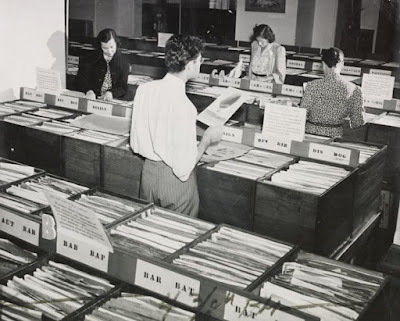
• Open‑shelf transformation (1930–32): Room 100 is rearranged; the Collection becomes browsable; clerical workers replace professional staff at the desk so librarians can do reference, classification, and outreach. Mounting on heavy board is stopped, and pictures circulate unmounted—this saves “time, labor, and expense,” reduces mending, and triples storage density. [RJ_Words, pp.17–18, 21]
• Reliance on relief labor (1932–35): Emergency Relief workers and later CWS/WPA staff (up to thirty‑two at once) clean, stamp, mend, reclassify, weed, and build the first large‑scale subject‑heading catalogue, which by 1938 has grown to over 200,000 entries. Their withdrawal in 1939 and again in 1943 precipitously stalls cataloging and exhibition work. [RJ_Words, pp.24, 28–29, 35–36, 77–81, 83]
• Curtailment policies: To cope with overuse, the Collection repeatedly:
o Reduces hours (closed two days a week for years in the early 1940s and again in 1952–53).
o Closes entire sections (geography, stills, reproductions of paintings) to the public.
o Restricts number of pictures per borrower (ultimately to five per subject, twenty‑five total).
o Cuts off inter‑branch loans and phone/mail service except in special cases. [RJ_Words, pp.34–35, 79–81, 89–90, 93–95, 101–102, 114–115]
• Furniture and equipment experiments: There are multiple rounds of trying steel cabinets, new folder designs, sorting shelves, hot‑mount presses, and fluorescent lighting, often accompanied by in‑house time‑and‑motion studies to reduce filing backlogs. Yet by 1948–50 the staff still call Room 73 “shockingly primitive” and “completely unsuited,” and make repeated recommendations for custom picture storage and a photocopy machine. [RJ_Words, pp.92–93, 95–97, 101–103, 107, 113–114]
These reports allow a researcher to connect policy decisions (open stacks, circulation caps, section closures) directly to measurable outcomes (circulation fluctuations, backlogs, reference load) and to broader issues: the place of visual materials in library budgets, the dependence on short‑term federal labor programs, and the gap between the Collection’s national/international role and its local funding.
6. Conceptual Shifts: Pictures as Documents
Finally, the reports and allied essays (“On Pictures in a Public Library,” “The Organization of Pictures as Documents,” “Words on Pictures”) show a conceptual shift that is itself analytically important:
• From the 1930s on, Javitz consistently positions the Picture Collection against art museums and fine print rooms. Museums, she writes, “select and appraise as works of art; the library collects and organizes as documents.” [RJ_Words, pp.12–13, 63]
• The annual reports reinforce this by treating all visual items—fine engravings, movie stills, trade cards, news photos—on the same footing as sources of facts, styles, and social evidence, regardless of artistic pedigree.
• This doctrine underlies many operational choices: inclusive subject headings; reluctance to weed on taste; willingness to clip from “ephemeral” sources; insistence on detailed sourcing and dating; willingness to lend fine materials.
For an analyst, this is not just professional rhetoric. It shapes how the Collection absorbs, classifies, and recirculates the visual residue of the twentieth century, and it helps explain why it becomes attractive to such a wide range of users, including federal archivists and photographers themselves.
Conclusion
The annual reports and statistical notes about the New York Public Library Picture Collection between 1914 and 1968 support several kinds of effective analysis:
• A quantitative reconstruction of stock and circulation growth, showing how quickly public demand outstripped library infrastructure.
• A sociology of users, tracking shifts from advertising and publishing toward government, television, and art‑school veterans, and documenting the Collection’s entanglement with federal visual programs.
• A business and economic history of the visual industries in New York, in which a public picture file functioned as a crucial input to commercial art, fashion, and media.
• A cultural barometer, using request lists as data on what topics, motifs, and technologies preoccupied different sectors of the city at different moments.
• An institutional and labor history of how a general public library integrated non‑book documents, reliant on relief programs and improvisational equipment.
• A theoretical case study in the treatment of pictures as documents rather than artworks, with practical consequences for classification, access, and preservation.
Because the reports mix statistics, policy, and vignettes, they offer both aggregate measures and micro‑level examples. Used carefully—triangulated with other sources and treated as both narrative and numeric evidence—they provide a strong foundation for reconstructing the history of visual literacy, documentary culture, and creative industry in mid‑twentieth‑century New York.
~~~


Comments
Post a Comment