A Professional Legacy
Romana Javitz’s career at the New York Public Library’s Picture Collection was not only about building a massive visual archive; it was equally about building a profession around that archive. She treated the Picture Collection as a laboratory for what a “picture library” could be, and then used that experience to help create a professional community—within the Special Libraries Association (SLA), in other libraries, and in graduate library education.
By the late 1940s and early 1950s, large numbers of special libraries—corporate, media, government, museum—were maintaining picture files and photographic archives. Most were subject-based and heavily used, but there were few shared standards for subject headings, storage, or research methods. In a 1965 interview, Javitz captured the situation bluntly: the field of picture libraries was “only three decades old… most picture collections have grown haphazardly and few even today are organized… the field is waiting for development, for recognition that pictures are an inseparable part of library service.” (Special Libraries, Jan. 1965, quoted in RJ_1980_TheaterLibrarianship_40322660.pdf, p. 52).
Her response was not simply to improve NYPL’s internal practices, but to push for a professional structure that could carry these ideas beyond New York.
The 1952 turning point
The decisive moment came in 1952. Javitz had already become a point of reference for picture librarians elsewhere. Around that time she met with Elsie Phillips of the Enoch Pratt Free Library, and picture collection staff from similar institutions “for an exchange of ideas and experiences in the picture field.” (RJ_Words_9781734640915_redo_ver2.epub, p. 176).
From that meeting she helped convene what she later called “the first picture session at a library convention,” held on May 27 at the Special Libraries Association conference. The attendance and response were strong enough that the group reconvened that evening in Room 73 of the NYPL Picture Collection:
“The response was so great that an extension of the session was held at the picture collection that evening. At this meeting, a professional organization of those concerned with pictorial documents was started as the Picture Division of the Special Libraries Association. The staff of this Library’s picture collection took the leadership in this development.”
(RJ_Words…, p. 176)
Within a single day, a loose group of practitioners talking about common problems turned into a formal division of SLA. Javitz and her staff did the organizing, provided the physical space, and supplied the conceptual agenda: pictures as documents, subject-based access, and the need for trained specialists.


Picturescope. Newsletter of the newly formed Picture Division at the Special Libraries Association. Vol. 1, No. 1, 1953.
Setting the agenda
What that new Picture Division was for is clear from the issues Javitz chose to stress:
* Methods and theory of subject headings for pictures.
* Standards for picture research in publishing, broadcasting, and technical fields.
* The organization of “picture archives” in government and media.
* Training of staff for work with still pictures, film stills, and other visual materials.
Her own articles in Special Libraries were aimed directly at these concerns. “Put Accent on Pictures” (1949) and “Picture Research” (1952) laid out practical and theoretical points about indexing, sourcing, and using pictures in special-library settings (RJ_PC and CCNY Bibliog.pdf, p. 17). When she later described the Picture Division’s emergence, she emphasized not glamour or novelty but the need for techniques and standards that matched the actual uses of pictures in industry and government.
The Picture Collection staff as a training ground
Javitz’s authority in the early SLA Picture Division did not come only from her own writing and lecturing. It came from the fact that the NYPL Picture Collection had become, under her direction, one of the few large-scale picture libraries that actually functioned at the level she hoped the field might reach.
Building a staff with dual expertise
From the 1930s onward, she deliberately recruited staff who had both art training and library training. Many assistants at the Picture Collection were practicing artists—designers, illustrators, photographers—who then added formal library-school education. By the mid-1940s she could report that “many of the staff are artists” and that they were called on “by public and the staff of the Library for information and reading guidance in the techniques and mediums of the graphic and plastic arts.” Their “technical appraisal of books” and their “first-hand knowledge of professional problems of the practicing artist and the beginner” made the Library’s resources more usable for the art world (RJ_Words…, 1946 report, pp. 151–152).
She did not take for granted that library schools would teach picture-specific skills. In fact, she complained explicitly that “similar classes are not given at library schools” and treated in‑service training as essential (RJ_Words…, 1947–48 report, pp. 154–155). From the late 1940s she organized internal seminars—two hours a day over two weeks—on:
* History of printed pictures and illustration.
* Picture-printing methods.
* Subject-heading theory specific to visual materials.
* Cataloging and sourcing of pictures.
* Applied classification schemes and subdivisions.
A “Style manual for the cataloging of books used in picture work” and a separate manual on subject headings for pictures grew out of this internal work (RJ_Words…, 1947–48 report, pp. 154–155). These manuals became tools both for training new assistants and for advising outside institutions.
Staff as consultants and exemplars
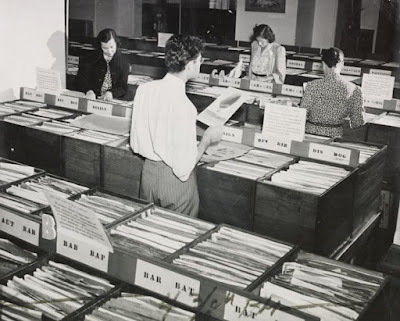
Because the Picture Collection implemented subject-based classification and multi-layered indexing (e.g., separate General, Geographic and Portraits files, an evolving list of 200,000+ headings, and a cross-index for film stills), other institutions began to treat it as a model.
Javitz reports that “each Thursday sees a librarian either from a business firm, museum, or a foreign country, seeking guidance on the organization of picture files.” The same day the British Information Service asked for subject headings for their photo files, a group of mothers from Parkchester came to learn how to start a picture file for their children’s school (RJ_Words…, 1947–48 report, p. 155). Staff members effectively became trainers for picture librarians elsewhere.
Curators from the Minnesota Historical Society and a librarian from North Carolina came to study classification and sourcing as they planned state-level pictorial archives (RJ_Words…, Five Year Report 1946–51, p. 172). Staff advised the Library of Congress’s Prints and Photographs Division on pictorial standards and cataloging practices (RJ_Worth Beyond Words_WaybackMachine_full_Illus.pdf, pp. 18–24). Picture Collection staff contributed to SLA workshops and articles on “visual indexing” and “filmstrips” (see citations to Tunstell and Falconer in PC and CCNY Bibliog.pdf).
This is where the Picture Division and the Picture Collection intersect most clearly. The Division provided a professional framework; the Picture Collection staff provided working examples, methods, and training that others could adopt. By the late 1950s the staff’s presence at SLA gatherings was routine. Staff News records that at the 1957 SLA convention in Boston, Romana Javitz “lectured at two seminars of the combined Museum and Picture Divisions… ‘The History of the Use of Printed Pictures as Documents’” (RJ_1957_V47N25_SLA_Boston_p.pdf). In 1962, Franziska Gay Schacht of the Picture Collection was national chair of the Picture Division and chaired joint sessions with the Museum Division at the SLA convention, while Javitz moderated a panel on “the status of picture archives in the United States” with Beaumont Newhall and Edward Steichen (RJ_1962_V52N24_SLA_WashDC_Schacht_p.pdf, p. 81–82).
In other words, Javitz’s staff did not simply execute her ideas in the NYPL stacks; they joined her in translating those ideas into a profession-wide conversation.
Formalizing picture librarianship at Pratt Institute
For most of her career, training in picture librarianship was ad hoc and in‑house. In the late 1960s, after four decades at NYPL, Javitz finally had the chance to take these methods into a graduate classroom.
Staff News notes, in her 1968 retirement announcement, that:
“In addition to her work at the Library, Miss Javitz also serves as consultant in the classification of still pictures and their use on the printed page, for display, and in films. She also has taught the organization of pictorial documents at Pratt Institute Graduate Library School. ‘Pictures from Abacus to Zodiac’ in The Story of Our Time (1955) is just one of several articles on picture librarianship which Miss Javitz contributed to professional publications.”
(RJ_1968_V58N14_RJ_retires_p.pdf, p. 50)
At Pratt she offered graduate-level seminars in “the organization of pictorial documents.” The course, as described in later commentary, addressed:
* The theory of subject headings for visual materials.
* Classification problems (e.g., Region/Style/Type/Year frameworks).
* Issues of storage, mounting, and preservation.
* The role of pictures in research, education, and propaganda.
Her teaching at Pratt fitted into a broader recognition that picture librarianship needed structured training. As one 1980 review of library education noted, “there were no courses specifically devoted to training for work with pictures… N.Y.P.L. developed an in-service, 60-hour seminar… Because of this lack, [Romana] Javitz also taught the organization of pictorial documents at Pratt Institute Graduate Library School” (RJ_1980_TheaterLibrarianship_40322660.pdf, p. 52).
Pratt represented two shifts: From on‑the‑job training to formal coursework with credit and academic framing, and from internal manuals to publicly shared theory, using her published pieces (“Pictures from Abacus to Zodiac,” “Still Pictures,” etc.) as core readings.
It also extended the influence of the Picture Division’s concerns into mainstream library education. Students who attended Pratt in those years carried forward ideas about visual classification and picture archives into other institutions—many of them not primarily art or media libraries.
A professional legacy
Romana Javitz spent forty years making the NYPL Picture Collection into a working encyclopedia of visual information, but she never treated it as an isolated unit. From the 1930s onward she understood that pictures were increasingly central to how information was communicated and that librarianship would have to respond.
Her staff at the Picture Collection were integral to this process. They were trained in picture-specific techniques, used as consultants and instructors, and assumed leadership roles in the SLA Picture Division. Their daily work—sorting millions of items, maintaining a 200,000‑entry subject catalogue, and handling complex picture inquiries—provided the practical grounding for Javitz’s vision of visual librarianship as a profession in its own right.
In that sense, the founding of the SLA Picture Division in 1952 is only one chapter in a longer effort: to make work with visual materials something more than ad hoc clipping and filing, and to give the librarians and archivists who handle these materials a shared language, set of standards, and professional home.
References
“Picturescope.” Newsletter of the Picture Division, Special Libraries Association. Vols. 1-35. 1953-1986.
Primary writings and reports by Romana Javitz and NYPL
- • Javitz, Romana. “On Pictures in a Public Library” (Grade 4 thesis, 1939). In:
Words on Pictures: Romana Javitz and the New York Public Library’s Picture Collection.
Photo Verso, 2020. RJ_Words_9781734640915_redo_ver2.epub, pp. 19–24. - • Javitz, Romana. “The Organization of Pictures as Documents” (Carnegie project paper, ca. 1941–43).
In: Words on Pictures. RJ_Words_9781734640915_redo_ver2.epub, pp. 12–13, 60–62. - • Javitz, Romana. “Words on Pictures.” Massachusetts Library Association Bulletin, 1943, pp. 19–23.
Reprinted in Words on Pictures. RJ_Words_9781734640915_redo_ver2.epub, pp. 112–119. - • Javitz, Romana. “Put Accent on Pictures.” Special Libraries, 15 Sept 1949, pp. 1235–1236.
Cited in PC and CCNY Bibliog.pdf, p. 16–17. - • Javitz, Romana. “Picture Research.” Special Libraries, July–August 1952, 43(7), pp. 209–210.
Cited in PC and CCNY Bibliog.pdf, p. 16–17. - • Javitz, Romana. “Images and Words.” Wilson Library Bulletin 18(3), Nov 1943, pp. 217–221.
Cited in PC and CCNY Bibliog.pdf, p. 15. - • Javitz, Romana. “Pictures from Abacus to Zodiac.” In: The Story of Our Time (Encyclopedic Yearbook 1955).
New York: The Grolier Society, 1955, pp. 334–335. RJ_Words_9781734640915_redo_ver2.epub, p. 267. - • Javitz, Romana. “Still Pictures.” Picturescope (SLA Picture Division), 15(1), 1967, pp. 2–6.
Cited in RJ_Words_9781734640915_redo_ver2.epub, p. 268. - • Javitz, Romana. Annual Reports of the NYPL Picture Collection, 1929–1939.
Bulletin of the New York Public Library, various volumes; excerpted in:
RJ_Words_9781734640915_redo_ver2.epub, Chapter Two, pp. 24–52; see 1929 report (Vol. 33, pp. 428–429),
1931 report (Vol. 35, pp. 386–388), 1937 report (Vol. 41, pp. 238–239). - • Javitz, Romana. Annual Reports of the NYPL Picture Collection, 1940–1953 (internal typescripts).
Transcribed in RJ_Words_9781734640915_redo_ver2.epub, Chapter Six, esp.
1941 report (Bulletin Vol. 45, pp. 282–284), 1946 report (pp. 147–151),
1947–48 report (Box 7, Picture Collection Records; RJ_Words…, pp. 152–155),
Five-Year Report 1946–51 (RJ_Words…, pp. 169–172), 1952–53 report (RJ_Words…, pp. 177–179). - • New York Public Library. “Retirement: Romana Javitz, Curator of Picture Collection.”
Staff News, Vol. 58, No. 14, 1968, p. 50. RJ_1968_V58N14_RJ_retires_p.pdf.
Professional interviews and commentary
- • Frankenberg, Celestine. “Specialization: Pictures. A Dialogue about the Training of Picture Librarians.”
Special Libraries, January 1965, 56(1), pp. 16–19. Includes Javitz’s remark that picture libraries are
“only three decades old… most picture collections have grown haphazardly…” (quoted in
RJ_1980_TheaterLibrarianship_40322660.pdf, p. 52). - • “Theater Librarianship: An Emerging Specialty.” (Review of library education).
Special Libraries, 1980; excerpt quoted in RJ_1980_TheaterLibrarianship_40322660.pdf, p. 52,
on NYPL’s 60-hour in-service seminar and Javitz’s teaching at Pratt Institute. - • Richard Doud interview with Romana Javitz, Archives of American Art (Smithsonian), 23 Feb 1965.
Transcript excerpted in RJ_Words_9781734640915_redo_ver2.epub, Chapter Nine, pp. 219–228. - • Robert Yampolsky interview with Romana Javitz, ca. 1964.
Transcript in RJ_Words_9781734640915_redo_ver2.epub, Chapter Eight, pp. 199–216. - • Romana Javitz interview with Sol Libsohn, 1958.
Transcript in RJ_Words_9781734640915_redo_ver2.epub, Chapter Seven, pp. 187–198.
Secondary studies and contextual sources
- • Troncale, Anthony T. “Worth Beyond Words: Romana Javitz and The New York Public Library’s Picture Collection.”
Biblion: The Bulletin of The New York Public Library, 4(1), Fall 1995, pp. 115–138.
Reproduced in RJ_Worth Beyond Words_WaybackMachine_full_Illus.pdf, esp. pp. 10–18, 23–25. - • Troncale, Anthony T. (ed.). Words on Pictures: Romana Javitz and the New York Public Library’s Picture Collection.
Photo Verso, 2020. EPUB: RJ_Words_9781734640915_redo_ver2.epub (preface and introduction by Jessica Cline
and Anthony Troncale, pp. 8–15; table of contents p. 7). - • Kamin, Diana, and Anthony T. Troncale. “‘Pictorially Yours’: The Correspondence of Joseph Cornell and Romana Javitz.”
Archives of American Art Journal, 64(1), Spring 2025. RJ_Pictorially Yours kamin-troncale-2025.pdf, pp. 3–4, 19–21. - • Kamin, Diana. Picture Work: How Libraries, Museums, and Stock Agencies Launched a New Image Economy.
Cambridge, MA: MIT Press, 2023. Cited in RJ_Pictorially Yours kamin-troncale-2025.pdf, p. 4. - • Beaudoin, Joan E., and Brady, Jessica Evans. “Finding Visual Information: A Study of Image Resources Used by
Archaeologists, Architects, Art Historians, and Artists.” Art Documentation, 30(2), Fall 2011, pp. 24–36.
Cited in PC and CCNY Bibliog.pdf, p. 17–18.
SLA Picture Division and visual indexing
- • Tunstell, Douglas. “Visual Indexing.” Special Libraries, 39(2), February 1948, pp. 39–42.
Cited in PC and CCNY Bibliog.pdf, p. 22. - • Falconer, Vera M. Filmstrips: A Descriptive Index and Users’ Guide.
New York: McGraw-Hill, 1948. Cited in PC and CCNY Bibliog.pdf, p. 18. - • Special Libraries Association. Picturescope (newsletter of the Picture Division), vols. 1–32, 1953–1987.
Cited in RJ_Words_9781734640915_redo_ver2.epub, p. 268; PC and CCNY Bibliog.pdf, p. 22.
NYPL archival and staff documentation
- • New York Public Library. Picture Collection Records, 1896–1999. Manuscripts and Archives Division.
Finding aid: http://archives.nypl.org/nypla/5850. Referenced throughout RJ_Words_9781734640915_redo_ver2.epub. - • Romana Javitz Papers, 1923–1980. Manuscripts and Archives Division, NYPL.
Finding aid: http://archives.nypl.org/mss/6197. Cited in RJ_Worth Beyond Words_WaybackMachine_full_Illus.pdf, notes 5–6, 10, 20. - • NYPL Staff News, 1915–1962. Vols. 1–52. Chronology in RJ_Words_9781734640915_redo_ver2.epub, Appendix II, pp. 258–262.
See especially: 1957_V47N25_SLA_Boston_p.pdf (Javitz’s SLA seminars in Boston);
1962_V52N24_SLA_WashDC_Schacht_p.pdf (Schacht’s chairmanship, Javitz’s panel), pp. 81–82. - • “SLA Notes: On the Picture Picture.” Staff News, Vol. 47, No. 25, 1957.
RJ_1957_V47N25_SLA_Boston_p.pdf (Javitz lectures on “The History of the Use of Printed Pictures as Documents”). - • NYPL Bulletin, various volumes, for Picture Collection annual reports and technical services statistics:
- o 1929 report: Bulletin Vol. 33, pp. 428–429 (RJ_Words…, p. 24).
- o 1930 report: Bulletin Vol. 34, pp. 422–424 (RJ_1930_NYPL_Bull_v34_see_p422_424_(p).pdf, p. 471).
- o 1931 report: Bulletin Vol. 35, pp. 386–388 (RJ_1931_NYPL_Bull_v35_see_p386_388(p).pdf, pp. 448–449).
- o 1934 report and WPA project description: Bulletin Vol. 38–39, pp. 373–375, 284–285 (RJ_1935_NYPL_Bull_v39.pdf;
RJ_1935_NYPL_Bull_v39_4pgsWPAreport(p).pdf, pp. 263–264, 284). - o 1937 report: Bulletin Vol. 41, pp. 238–239 (RJ_1937_NYPL_BULL_v41_see_p238_239(p).pdf, pp. 269–270).
- o 1939 report and WPA subject-heading catalogue note: Bulletin Vol. 43, pp. 258–260, 233–234
(RJ_1939_NYPL_Bull_V43a_see_p256_260(p).pdf, pp. 258–259, 285).
Other contextual sources
- • Thompson, Ruth. “The Collection and Preservation of Local Historical Pictures in the Minneapolis Public Library.”
The American Archivist, 9(3), July 1946, pp. 219–225. RJ_1946_SAA_40288517.pdf, p. 5. - • Peterson, Olga M. “A Central Picture Clearing House.” ALA Bulletin, 35(6), June 1941, pp. 384–386.
Cited in PC and CCNY Bibliog.pdf, p. 22. - • Karpel, Bernard. “A Talk on Images & Words in a Library.” Picturescope, 11(1), April 1963, pp. 6–7.
Cited in PC and CCNY Bibliog.pdf, p. 20.


I just stumbled across Javitz's work researching Dorothea Lange. This is all so interesting and impressive! Kind regards, MB
ReplyDelete