The NYPL Picture Collection as a Midtown Nexus

42nd Street entrance to NYPL Central Bldg. where Central Circulation was located in the now named Celeste Bartos Forum. (top left) Berenice Abbott's Tempo of the City: II, Fifth Avenue at 42nd Street, Looking west from Seymour Building, 503 Fifth Avenue. 1937. Changing New York. NYPL Wallach Photography Collection.
Location, Location, Location: The NYPL Picture Collection as a Midtown Nexus
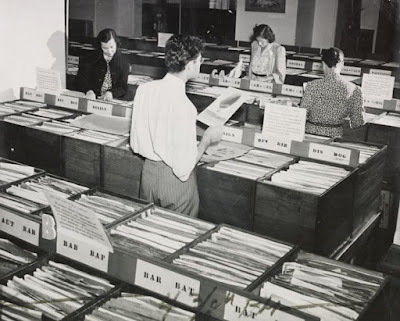
The Picture Collection’s location at 42nd Street and Fifth Avenue put it at the center of a mid‑20th‑century image machine. Within a short walk were nearly all the industries that produced, circulated, and monetized images: newspapers and magazines, publishers, fashion houses and garment manufacturers, film and theatre studios, radio and later television networks, advertising agencies, and department stores. That geography is not incidental. It explains why the Picture Collection became, in Romana Javitz’s phrase, a “giant encyclopedia where pictures are consulted instead of the printed word” and why it functioned as infrastructure for New York’s industrial image economy.
What follows sketches that geography and shows, with concrete examples, how firms and workers in Midtown used the Picture Collection and helped turn it into a major public visual resource.
1. Fifth Avenue and Times Square: theatre, film, and display
A few blocks west of 42nd and Fifth lay Broadway and Times Square, dense with theatres, vaudeville houses, and movie palaces. Their production pipelines depended on visual research—costumes, sets, props, and publicity imagery—that the Picture Collection supplied.
Theatre and set design
From the 1920s onward, scenic designers and prop houses used the files to reconstruct historical periods and foreign locales. Annual reports and later summaries note that:
- Scenic designers borrowed images of period interiors, architecture, and props to stage productions ranging from Shakespeare to new plays. In the mid‑1940s, “stage designs for costume and sets” surged, and the Picture Collection “served ballet, opera, Shakespeare revival and a Mae West production of Catherine Was Great” (Words_9781734640915_ver2.epub pp. 140–141).
- A director asked for lynching photographs to help actors grasp the gravity of a play in rehearsal (RJ_Words on Pictures_PDFp.pdf p. 156). The photographs functioned as psychological and historical reference as much as visual model.
This activity was geographically enabled: designers working in Broadway houses and scene shops could walk or take a short subway ride to the Library, browse in person, and carry folders back to their studios.

[Vaudeville Theater advertising the silent movie Tigris next to the Brill Building at 46 Broadway, Times Square.] c.1913. Collection of the author.
Motion picture studios and stills
Before the industry consolidated in Hollywood, New York hosted major studios in Long Island City and New Jersey. Even after that shift, Manhattan remained a center for distribution and publicity. Studios became both donors and users:
- By the early 1930s the Collection had received 40,000 motion picture “stills” as gifts in a single year (RJ_Words on Pictures_PDFp.pdf p. 31). These came from companies such as Famous Players‑Lasky, Columbia Pictures, UFA Films, RKP Productions, and others listed as principal donors (RJ_Words on Pictures_PDFp.pdf pp. 30–31).
- The Collection in turn lent stills to studios and publicity departments as reference for period costumes, crowd scenes, and historical reconstructions. When the stills file had to be closed for lack of proper housing, Javitz explicitly noted that this “hindered research workers and illustrators who have had no other source from which they could borrow photographs which reconstruct the customs of other times and places” (Words_9781734640915_ver2.epub p. 129).
Here the loop is clear: studios around Times Square and the West Side sent their discarded stills uptown, where they were cataloged, then returned—via the Picture Collection’s subject files—to the same industry as documentary resource.
Department stores and window display
Fifth Avenue stores and Times Square retailers drew heavily on the Collection for display ideas:
- The Library documented “outstanding window displays” in New York City with photographs, building a file of contemporary commercial design (Words_9781734640915_ver2.epub p. 34; RJ_Worth Beyond Words_WaybackMachine_full_Illus.pdf p. 12).
- Display schools and store training programs treated the Collection as required infrastructure. At the opening of “the first school window display in the city,” the director insisted that students first acquire “a thorough familiarity with the picture files of the Library, which she considers indispensable” (RJ_Words on Pictures_PDFp.pdf p. 41).
- Window dressers borrowed images both for historical themes (e.g., patriotic drives, seasonal tableaux) and for motifs that could be turned into patterns or props—“tropical leaves” inspiring jewelry settings, or cowboy gear feeding a Western fad in children’s goods (RJ_Words on Pictures_PDFp.pdf pp. 156–157; Words_9781734640915_ver2.epub p. 164).
The short radius between Fifth Avenue flagships and 42nd Street made it practical for display staff to browse, borrow, and return images on tight commercial schedules.
2. Northward: Rockefeller Center, broadcasters, and publishers
North of the Library, roughly from the 40s to the 50s, lay Rockefeller Center, the new headquarters for radio and later television networks, and clusters of magazine and book publishers along Sixth Avenue and beyond.
Radio and television
Broadcast media relied on pictorial documentation in at least three ways: set and costume design, on‑air graphics (maps, logos, title cards), and research for scripts and educational content.
- During World War II and after, network training and information units came regularly. The War Department Film Production laboratories and the Office of War Information used the files for “visual kits, animated cartoons and training films” (Words_9781734640915_ver2.epub pp. 138, 143).
- In the late 1940s and early 1950s, as television took off in Rockefeller Center, scriptwriters and producers “began to use the picture files” heavily. They stayed for hours “searching out the historical past,” and network librarians held “frequent meetings with the picture collection staff” to coordinate use (Words_9781734640915_ver2.epub p. 175).
- Producers preparing telecasts of historical dramas consulted the Collection for precise iconography: pictures borrowed “served to dress Helen Hayes’ hair for a television performance as Elizabeth Barrett Browning; [and] helped the make‑up of an aspirant for the role of Caligula in the film version of The Robe” (Words_9781734640915_ver2.epub p. 174). Another researcher sought portraits of past presidents to form the backdrop of a televised address from the White House (ibid., p. 174).
These are all midtown jobs: studios at Rockefeller Center and on the West Side needed a walk‑in image service. The Picture Collection’s hours and open‑shelf policy made it the de facto research department for broadcasters who could not maintain comprehensive archives in‑house.

Berenice Abbott (1898-1991)."Rockefeller Center, From 444 Madison Avenue" Changing New York. 1937. NYPL Wallach Photography Collection.
Magazine and book publishers
Midtown and nearby housed the headquarters of Life, Look, Harper’s Bazaar, The New Yorker, and major book houses. The Picture Collection was tightly woven into their workflows.
On the supply side:
- Newspapers and magazines “with all [their] productive exuberance, generated massive amounts of printed media” that “ended up in the Picture Collection’s stock” (RJ_Words on Pictures_PDFp.pdf p. 8; Words_9781734640915_ver2.epub p. 11).
- The New York Times, the Herald Tribune, Newsweek, and others regularly donated current news photographs. In 1937 gifts reached 104,167 items, including large groups of photographs from The New York Times and the Resettlement Administration (Words_9781734640915_ver2.epub pp. 44–45).
- The Library also purchased tens of thousands of photographs of artworks from the Frick Art Reference Library in 1936 (RJ_Worth Beyond Words_WaybackMachine_full_Illus.pdf p. 12).
On the demand side:
- Magazine art departments came to the Collection for spot illustrations and background documentation. An exhibit on “the spot use of drawings”—supplied by artists from The New Yorker, New Masses, Esquire, and Harper’s Bazaar—was itself based on work that had drawn heavily on Picture Collection files (RJ_Words on Pictures_PDFp.pdf p. 47).
- A State Department researcher based in Washington, working on an overseas presentation of “America’s contribution to Letters and Art,” traveled specifically to the Picture Collection because “nowhere else can we find this material against a deadline and too, find it in shape for immediate use.” She selected 200 prints in a single morning (Words_9781734640915_ver2.epub p. 163).
- Book publishers used the Collection for illustrated histories, encyclopedias, and language manuals. Postwar, the rise of “picture histories and new editions of picture encyclopedias” led to increased use of the Library’s image resources (Words_9781734640915_ver2.epub p. 141). The staff in turn reviewed art books systematically to guide branch acquisition, positioning the Picture Collection as a knowledge hub for the entire NYPL system (Words_9781734640915_ver2.epub pp. 151, 167, 172).


Newsstand, 32nd St. and Third Ave. Nov. 19, 1935. Berenice Abbott. NYPL Wallach Photography Collection.
Spatially, the Picture Collection sat between publishers clustered around Bryant Park, Times Square, and Rockefeller Center. Editors could send assistants across the street or a few blocks south and expect same‑day results.
3. Eastward: Grand Central, Madison Avenue, and advertising
To the east stood Grand Central Terminal and, running north, Madison Avenue—the postwar shorthand for the advertising industry. Agencies here needed a constant flow of visual motifs, symbols, and documentary facts.
Madison Avenue agencies and corporate art
By the late 1930s and 1940s, advertising agencies and corporate art departments were among the Collection’s heaviest users:
- In 1934 the Picture Collection reported that commercial agency use, which had dipped in the early Depression, had “restored to greater activity” (Words_9781734640915_ver2.epub p. 124).
- By 1950–51, more than 1,200 firms and organizations were registered as picture borrowers, including advertising agencies, film companies, banks, pharmaceutical firms, and manufacturers (RJ_Words on Pictures_PDFp.pdf pp. 155, 157; Words_9781734640915_ver2.epub pp. 167, 172). Registration rose sharply in those years, with a “100% increase in the number of firms registered” in just six months (RJ_Words on Pictures_PDFp.pdf p. 155).
- An Advertising Age feature in 1951 described admen haunting the Picture Collection’s “storeroom of 6,000,000 pictures” when their own files and commercial agencies failed (RJ_Words on Pictures_PDFp.pdf p. 264).
Requests documented in the annual reports show the specificity of the advertising demand:
- A copywriter preparing commercials “directed to Americans of Mexican origin” studied pictures of Mexican immigrants’ living conditions to orient his broadcasts (Words_9781734640915_ver2.epub p. 164).
- For a whiskey advertisement, designers borrowed pictures of magnolia blossoms, a motif that also appeared on kitchen toweling, greeting cards, and costume jewelry (Words_9781734640915_ver2.epub pp. 164–165).
- A manufacturer designing cotton goods for Lend‑Lease sought patterns that would be “familiar and in colors popular among the native peoples of a certain African colony” and found them via the Picture Collection’s folk art and costume files (Words_9781734640915_ver2.epub p. 141).
The Madison Avenue ecosystem depended on speed and volume. Having an image archive within a ten‑minute walk, open all day, changed how art directors worked. Instead of commissioning original photography for every campaign, they could browse a pre‑indexed universe of imagery and use it either directly (through reproduction rights) or indirectly (as conceptual source).
Corporate industrial design
Beyond advertising, industrial design firms and in‑house corporate art departments—many located in Midtown or nearby—used the Collection to visualize products and environments:
- Designers came for “shapes of forms in nature, from the artifacts of primitive man, from cross‑sections of engines” to derive patterns and forms for “mass‑produced china, furniture, packaging, shoes and fabrics” (Words_9781734640915_ver2.epub pp. 164–167, 170).
- Automobile and railroad designers used details such as air views of airports and plant skylines as inspiration for textile prints and streamliner interiors (Words_9781734640915_ver2.epub pp. 39, 164).
- An atomic energy laboratory turned to the Picture Collection to locate images of “the heart of the guinea pig” for scientific illustration (RJ_Words on Pictures_PDFp.pdf p. 157).
Again, proximity mattered. Designers could come on their lunch break, or send junior staff over with precise written requests, and return with reusable visual data.
4. South and across Midtown: garment and fashion districts, photographers, and artists
Below Times Square on Seventh Avenue and westward lay the garment district; east and north, fashion houses and specialty manufacturers. Just as crucial were the artists and photographers whose studios were scattered throughout Midtown and lower Manhattan but who congregated daily around 42nd Street.

The NYC Garment District, roughly 24th St. to 42 St on Manhattan's west side, employed thousands in its heyday and designers of textiles, accessories, and high fashion regularly used the Picture Collection's stock for new ideas and patterns. Federal Art Project-Photographs Div. - NYPL Wallach Picture Collection.
Garment and fashion industries
The Picture Collection became the garment district’s unofficial design library:
- By the mid‑1930s, the “centering of fashion design in this city brought a greater dependence on these files for costume history and ideas” (Words_9781734640915_ver2.epub p. 128).
- Textile designer Ruth Reeves, scenic artist Albert Johnson, sculptor Gaston Lachaise, and muralist Diego Rivera were cited as regular users (Words_9781734640915_ver2.epub p. 39). Reeves would later co‑administer the Index of American Design, which arose directly from artists’ frustration at the lack of visual records of American crafts (RJ_Words on Pictures_PDFp.pdf pp. 62–63; RJ_Worth Beyond Words_WaybackMachine_full_Illus.pdf pp. 8–9).
- In the postwar years, as American designers looked to domestic tradition rather than Paris, the Collection’s files on “Ohio flatboats, Charleston balustrades, corncribs, cowboys, gold mining, cotton… samplers, and silos” were used “as a basis for fresh design” in fabrics and garments (Words_9781734640915_ver2.epub pp. 39, 62).
Location was crucial for this sector: cutters, pattern makers, and designers in loft buildings a few blocks west could drop in repeatedly as they iterated designs, rather than relying solely on in‑house sketch libraries.

Dan Freeman (1908-1978). "Garment District" 1934. Lithograph. Public Works of Art Project (U.S.) (Sponsor) NYPL Wallach Picture Collection.
Artists and photographers
The Collection’s central position also made it a daily resource for artists with studios throughout Manhattan and beyond:
- Muralists on federal projects used the files to ground large public works in documented scenes of American life. The Public Works of Art Project painters for Radio City Music Hall, for example, designed “rugs, stage‑sets, murals, metalwork, and sculpture” with the aid of the Library’s picture files (RJ_Words on Pictures_PDFp.pdf p. 35).
- Photographers such as Berenice Abbott, Walker Evans, Dorothea Lange, and Lewis Hine all intersected with the Picture Collection and its staff. Abbott’s Changing New York photographs were deposited there before being transferred to research divisions (Words_9781734640915_ver2.epub pp. 50–51, 254–255). Evans photographed Picture Collection exhibits and used the postcard files as raw material; Cornell used it extensively as a “favorite haunt” for collage sources (RJ_Pictorially Yours kamin-troncale-2025.pdf pp. 7–9).
- For returning veterans in art schools, instructors required visits so that students could learn how to mine the files “for their future professional work,” embedding the Collection in Midtown’s art education ecology (RJ_Words on Pictures_PDFp.pdf p. 155).
Because the Library sat at a transportation hub—near Grand Central, Times Square, Penn Station reachable by subway—it acted as a central node where visual workers from different neighborhoods crossed paths, sharing a common resource even if they never met.
5. From Midtown node to “infrastructure for democratic culture”
Geography alone did not make the Picture Collection important; the way it took advantage of that geography did. Situated at the intersection of Broadway theatre, Seventh Avenue fashion, Rockefeller Center broadcasting, Madison Avenue advertising, and the city’s publishing corridor, the Collection:
- Captured industrial overflow – The “massive amounts of printed media on paper” produced by Midtown (advertisements, magazine covers, news photographs, studio stills) flowed into the Collection’s subject‑organized files rather than into the trash (RJ_Words on Pictures_PDFp.pdf p. 8; Words_9781734640915_ver2.epub p. 11).
- Returned it as public resource – Those same industries then came back for visual documentation: not only elite artists but “theatres, publishers, advertising agencies, printers, barbers and wig makers,” as the 1931 report dryly enumerates (RJ_Words on Pictures_PDFp.pdf p. 20).
- Linked commercial and civic worlds – The geography meant that a union preparing an exhibit, a state agency designing public health posters, and a Madison Avenue firm planning a campaign might be drawing from the same folders. Javitz noted with some satisfaction that “the same pictures used for both sides” of a mayoral campaign—La Guardia, Hillman, Dewey—left interpretation to captions and context (Words_9781734640915_ver2.epub p. 142).
In Javitz’s own assessment, the result was a kind of visual commons:
“American creative output is influenced in a great measure by this library service. An endless procession of art in industry derives from the Picture Collection: fabric, stage sets, dress, ornament, jewelry, toys, window displays, book production…. It may be likened to a giant encyclopedia where pictures are consulted instead of the printed word.” (RJ_Worth Beyond Words_WaybackMachine_full_Illus.pdf p. 17)
The central Midtown location made that “encyclopedia” physically reachable by the very people generating and circulating most of the country’s images. In turn, their heavy use and continuous donations made the Picture Collection larger, more current, and more varied than it could ever have been as a remote, elite archive. It became, quite literally, where Madison Avenue and Broadway went to look things up.
References
Worth Beyond Words: Romana Javitz and the New York Public Library’s Picture Collection. Published in the Library's journal, Biblion: The Bulletin of The New York Public Library. Volume 4, Number 1, Fall 1995. ©1995 Anthony T. Troncale. (Cited as: RJ_Worth Beyond Words_WaybackMachine_full_Illus)
An exhibition co-curated with Julia Van Haaften, Subject Matters: Photography, Romana Javitz, and The New York Public Library, was on view through March of 1998 in the Stephen A. Schwarzman Building (then known as the Humanities and Social Sciences Library).
Kamin, Diana and Anthony T. Troncale. “Pictorially Yours”: The Correspondence of Joseph Cornell and Romana Javitz. Archives of American Art Journal. Volume 64, Number 1Spring 2025. (Cited as: RJ_Pictorially Yours kamin-troncale-2025)
Troncale, Anthony T. editor. Words On Pictures: Romana Javitz and the New York Public Library’s Picture Collection. Photo | Verso Publ. LLC. 2020. New York. 274 pp.
(Cited as: Words_9781734640915_ver2.epub or RJ_Words on Pictures_PDFp)
~~~~~~~~~~~~~~~~~~~~~~~~~~~~~~~~~~~~~~~~~~~~~~~~~~~~~~~~~~~~

Comments
Post a Comment